
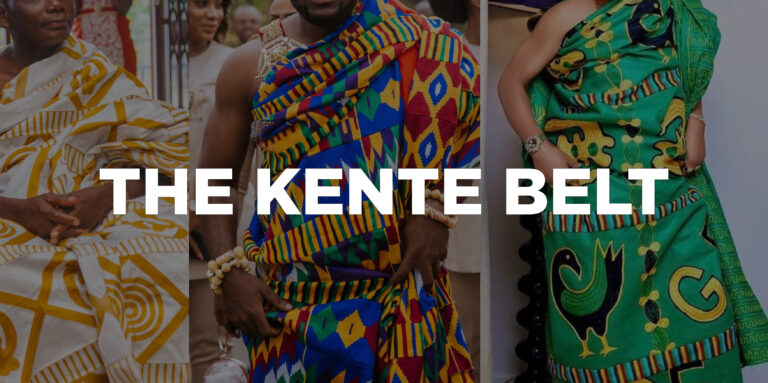
The Kente Belt: Understanding the Art and Craftsmanship of the Owontoma
When people think of kente cloth, they often picture the large, flowing robes worn by chiefs and dignitaries at grand ceremonies. But woven into the very structure of kente is a smaller, often overlooked element that plays a vital role in both the construction and the aesthetic of the cloth: the owontoma, commonly known as the kente belt or border band.
The owontoma is more than just a decorative edge. It is a structural component that defines the boundaries of the woven strip, provides stability, and serves as a canvas for some of the most intricate patterns in all of kente design. Understanding the owontoma deepens one's appreciation for kente weaving as a complete art form.
What Is the Owontoma?
The term "owontoma" comes from the Akan language and roughly translates to "the finished edge" or "the border." In kente weaving, the owontoma refers to the narrow, densely woven band that runs along one or both edges of each kente strip. While the central portion of the strip contains the main patterns and motifs, the owontoma frames these designs, giving each strip a clean, defined border.
Traditionally, the owontoma was woven using a contrasting color scheme to the main body of the strip, creating a striking visual frame. This contrast not only adds beauty but also helps distinguish one weaver's work from another, as the owontoma often serves as a signature of the artisan's skill and style.
The Role of the Owontoma in Kente Structure
The owontoma serves several critical functions in the overall construction of kente cloth:
- Structural integrity: The tight, dense weave of the owontoma reinforces the edges of each strip, preventing fraying and ensuring that the strip maintains its shape during weaving, handling, and eventual assembly into a full cloth.
- Strip alignment: When multiple strips are sewn together to form a complete kente cloth, the owontoma provides a consistent reference point for alignment. Skilled sewers use the owontoma to ensure that strips are joined evenly and symmetrically.
- Visual framing: Just as a picture frame enhances a painting, the owontoma enhances the visual impact of kente patterns by providing a clean, contrasting border that draws the eye inward toward the main design.
- Cultural identity: Different regions and weaving families have distinct owontoma styles. The patterns, colors, and techniques used in the owontoma can identify the origin of a kente cloth, much like a watermark on a document.
How the Owontoma Is Woven
Weaving the owontoma requires a different technique than the main body of the kente strip. While the central patterns are often created using supplementary weft techniques (where additional threads are woven into the base to create raised designs), the owontoma is typically woven using a warp-faced plain weave. This means the warp threads (the vertical threads stretched on the loom) are packed closely together, completely covering the weft threads and creating a dense, smooth surface.
The weaver must maintain consistent tension and thread count throughout the owontoma to ensure it is uniform in width and texture. This demands considerable skill and experience, as even small variations can result in an uneven border that detracts from the overall quality of the cloth.
In traditional Ashanti kente weaving, the owontoma is usually woven first, setting the foundation for the rest of the strip. The weaver establishes the width of the owontoma, threads the loom accordingly, and then transitions into the main pattern area. This sequence requires careful planning, as the owontoma must be proportionate to the overall strip width.
Why the Owontoma Matters for Quality
The quality of the owontoma is one of the most reliable indicators of overall kente cloth quality. A poorly woven owontoma — uneven, loose, or inconsistent — is a sign that the weaver may lack skill or has rushed the work. Conversely, a precise, tightly woven owontoma signals mastery and attention to detail.
When evaluating kente cloth, look closely at the owontoma. It should be straight, uniform in width, and tightly woven with no loose threads or gaps. The color should be vibrant and consistent, and the transition from owontoma to the main pattern should be clean and deliberate. These details may seem small, but they separate exceptional kente from mediocre imitations.
Different Styles of Owontoma
The owontoma is not a one-size-fits-all component. Different weaving traditions produce distinct owontoma styles:
- Single-color owontoma: The most common style, featuring a solid color that contrasts with the main body of the strip. This style is prevalent in Ashanti kente.
- Multi-colored owontoma: Some weavers incorporate two or more colors into the owontoma, creating a striped or patterned border. This style is often seen in Ewe kente.
- Wide owontoma: In certain ceremonial cloths, the owontoma is proportionally wider, giving the border greater visual prominence. This is typically reserved for prestigious or royal commissions.
- Narrow owontoma: Everyday or fashion kente may feature a narrower owontoma, creating a more subtle border that allows the main patterns to dominate.
Hinkro Kente and the Owontoma Tradition
At Hinkro Kente, the owontoma is treated with the reverence it deserves. Our weavers understand that the border is not an afterthought but an integral part of the cloth's identity. Every piece that leaves our workshop features an owontoma that has been carefully woven to exacting standards.
We also recognize that the owontoma offers an opportunity for creative expression. For bespoke orders, we work with clients to design custom owontoma patterns and color schemes that complement their vision. Whether you want a traditional solid-color border or a more contemporary multi-toned design, our artisans have the skill and experience to deliver.
The owontoma is a testament to the completeness of kente artistry. It reminds us that in kente weaving, every element matters, from the grandest pattern to the smallest border detail. When you wear a Hinkro Kente cloth, the owontoma quietly declares the quality and care woven into every inch of the fabric.